Harvard University is the most recognised academic institution in the world, and for African students with ambition, talent, and a clear sense of purpose, it is not simply a dream. It is an achievable goal — provided you understand the financial support systems that Harvard has built, the specific scholarship programmes available, what they cover, how the application works, and how to position yourself as the kind of candidate Harvard invests in.
Let us be direct about something that most scholarship guides do not say clearly enough: Harvard is one of the most financially generous universities in the world for students who demonstrate financial need. Harvard’s endowment — the largest of any university on earth — funds a financial aid programme that is genuinely extraordinary in its scope and its commitment. Over 55 percent of Harvard students receive financial aid. Students from families earning below $85,000 per year pay nothing to attend Harvard. Students from families earning between $85,000 and $150,000 pay no more than 10 percent of their family income. These commitments apply to international students, including students from Nigeria, Ghana, Kenya, South Africa, and every other African nation, in exactly the same way they apply to American students.
This article covers every significant scholarship and financial aid pathway available to African students at Harvard, the specific application process for each, and the strategies that give your application the strongest possible foundation.
Harvard Financial Aid — Not a Scholarship, But Better Than Most Scholarships
The first and most important thing to understand about funding a Harvard education is that Harvard does not primarily operate through named scholarship competitions the way many other universities do. Instead, Harvard operates a need-based financial aid programme that assesses every admitted student’s financial circumstances and provides a funding package that makes attendance affordable — regardless of where in the world that student comes from.
For undergraduate students, the Harvard College Financial Aid Programme applies to all admitted students, including international students from Africa. If you are admitted to Harvard College, Harvard will meet 100 percent of your demonstrated financial need. For students from families with annual incomes below $85,000, Harvard charges no parental contribution whatsoever — tuition, housing, meals, health insurance, and personal expenses are fully covered by Harvard grant funding. Students from families earning between $85,000 and $150,000 contribute between zero and 10 percent of their family income. Students from families earning above $150,000 contribute on a sliding scale that is still significantly below the full cost of attendance.
This means that for most African students — whose family incomes fall well below the $85,000 threshold when assessed on an equivalent basis — a Harvard undergraduate education is genuinely free. The application for this funding is the standard Harvard financial aid application, submitted through the CSS Profile administered by the College Board and through Harvard’s own financial aid supplement.
The Harvard Kennedy School — International Fellowships for Future Leaders
The Harvard Kennedy School of Government offers the most significant named scholarship opportunities at Harvard that are specifically relevant to African students with backgrounds or interests in public policy, governance, international development, economics, law, and public administration.
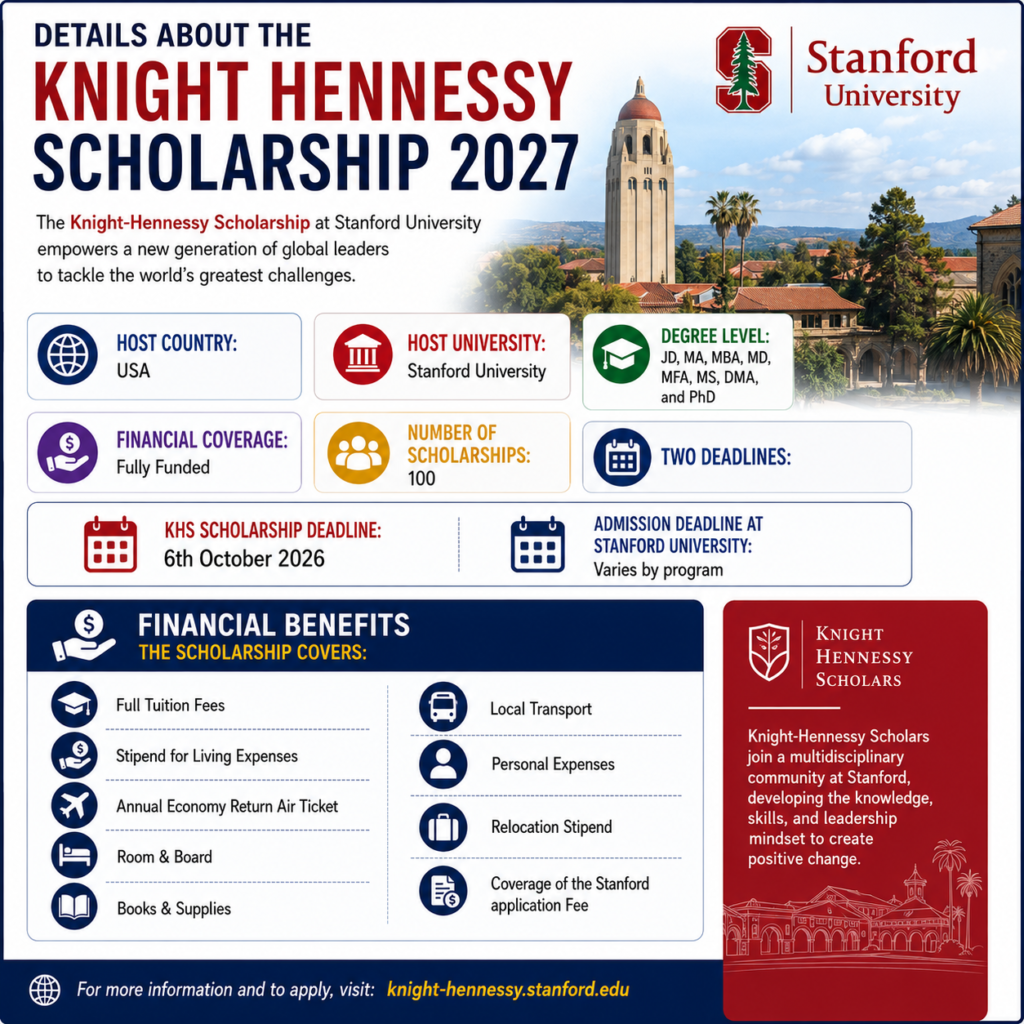
The Knight-Hennessy Scholars Program at Harvard accepts a small number of Harvard-bound graduate students across all Harvard schools, including the Kennedy School, and provides full funding — tuition, stipend, and living expenses — for the duration of the programme. Knight-Hennessy is open to graduate students from any country and any field, and it selects on the basis of civic mindset, collaborative leadership, and capacity for independent thinking. African students with documented records of public service, policy engagement, community leadership, and professional excellence are genuinely competitive candidates for Knight-Hennessy.
Note: While administered at Stanford, Knight-Hennessy fellows attend their home institution including Harvard. The application is submitted through the Knight-Hennessy programme directly.
The Harvard Kennedy School Fellowship Programmes include the Lucius N. Littauer Fellowship, which provides need-based funding for mid-career professionals pursuing the Master in Public Administration, and the Mason Programme Fellowships, which fund senior public officials and practitioners from developing countries pursuing the MPA/MC-MPA degrees. The Kennedy School also administers the International Leadership Fellowship and the Aga Khan Foundation Fellowship for students from developing countries.
The Harvard T.H. Chan School of Public Health — Africa Health Fellowships
The Harvard T.H. Chan School of Public Health is one of the world’s leading public health research and education institutions, and it has a specific and sustained commitment to supporting public health education for professionals from sub-Saharan Africa and other developing regions.
The Harvard Chan Africa Regional Fellowship provides full funding — including tuition, living stipend, health insurance, and round-trip airfare — for mid-career public health professionals from African countries to pursue the Master of Public Health or the Master of Science in Epidemiology. Selection is based on professional experience, leadership potential, and commitment to returning to Africa to apply the skills developed at Harvard Chan in addressing public health challenges on the continent.
The Takemi Program in International Health provides fellowships for mid-career health professionals from developing countries to spend one year at Harvard Chan conducting health policy and systems research. Takemi Fellows receive a stipend, health insurance, and research support but not tuition — the fellowship is a research experience rather than a degree programme.
The Harvard Chan School also participates in the Intra-Africa Academic Mobility Scheme and has partnerships with several African universities through which jointly supported scholarship places are made available. Check with your current university to determine whether a partnership with Harvard Chan exists that could provide a supported pathway.
Harvard Business School — 2+2 Programme and MBA Fellowships
The Harvard Business School MBA programme is one of the most competitive and most globally prestigious in the world. HBS does not offer merit-based scholarships for the MBA — all financial aid is need-based — but the need-based financial aid programme is generous and applies to international students from Africa in exactly the same way it applies to American students.
African students admitted to the Harvard Business School MBA programme who demonstrate financial need receive HBS Fellowship grants that can cover up to the full cost of tuition and living expenses. Students with the greatest financial need receive the largest grants. The application for HBS financial aid is submitted after admission is granted and involves a detailed assessment of the student’s financial circumstances.
The HBS 2+2 Programme is a deferred enrolment option for current undergraduate students who want to apply for HBS during their final year of university, with enrolment deferred for two to four years to allow professional experience to be gained first. African undergraduate students at accredited universities — including African universities — are eligible to apply for the 2+2 programme, and those who are admitted receive a deferred place that can be taken up after gaining the required work experience. Financial aid is available on the same need-based terms for 2+2 students when they enrol.
Harvard Law School — LLM and SJD Scholarships for African Lawyers
The Harvard Law School offers the most prestigious legal education in the world, and its LLM programme draws hundreds of internationally trained lawyers every year from every country and every legal tradition. The SJD — Doctor of Juridical Science — is Harvard Law’s doctoral degree for students pursuing advanced legal scholarship.
Harvard Law School provides merit and need-based fellowship funding to LLM students through its Graduate Program Fellowships. The application for fellowship consideration is submitted alongside the LLM application and involves an additional essay explaining the applicant’s financial circumstances and professional background. African lawyers with strong academic records, documented professional experience in public interest law, human rights, international law, constitutional law, or development law, and a clear statement of how their Harvard LLM experience will contribute to legal development in Africa are competitive candidates for fellowship consideration.
The Satter International Human Rights Fellowship at Harvard Law School is specifically designed for LLM students committed to careers in international human rights, and it provides full funding for tuition plus a living stipend. African students with backgrounds in human rights documentation, advocacy, public interest litigation, or refugee law are particularly well-positioned for this fellowship.
Harvard Graduate School of Arts and Sciences — PhD Fellowships
The Harvard Graduate School of Arts and Sciences administers doctoral programmes across the social sciences, humanities, natural sciences, and engineering. In virtually every GSAS doctoral programme, all admitted students receive a full funding package — tuition, stipend, and health insurance — for the duration of their PhD, which typically runs five to six years.
This means that admission to a Harvard GSAS doctoral programme is effectively the same as receiving a fully funded scholarship. African students who are admitted to Harvard PhD programmes in economics, political science, sociology, history, anthropology, comparative literature, chemistry, biology, physics, computer science, or any other GSAS discipline receive full funding as a standard component of their admission.
The key implication of this structure is that the strategy for African students pursuing Harvard PhD funding is not to search for scholarship competitions but to pursue the strongest possible PhD application — which means identifying the Harvard faculty members whose research interests align most closely with your own, developing a compelling research proposal that demonstrates both intellectual ambition and academic feasibility, and submitting an application that showcases the full depth of your academic preparation and potential.
How to Write a Harvard Application That Gets Funded
The Harvard application — for any school — rewards intellectual honesty, specific ambition, and genuine self-knowledge above all other qualities. The admissions essays and personal statements required for Harvard applications are not exercises in describing your achievements. They are exercises in demonstrating who you are as a thinker, as a person, and as someone with a specific and credible vision of how a Harvard education will enable you to do something that genuinely matters.
For African students, the richness and specificity of your professional and community context — the real challenges you have navigated, the specific problems you have worked on, the concrete impact you have created — is a genuine advantage if you present it with honesty and detail rather than trying to frame your experience in terms that imitate the experiences of American or European applicants. The Harvard admissions process values diversity of perspective and experience, and an application that speaks honestly and specifically about building a healthcare system in a context of severe resource constraints, or practising law in a system that is still developing its constitutional foundations, or teaching in schools that lack basic infrastructure while still finding ways to inspire students to excellence — these stories carry authentic weight and genuine distinction.
Be specific in every essay. Replace general aspirations with specific plans. Replace credential lists with experience narratives. Replace abstract commitments with documented actions. The application that wins Harvard funding is the one that allows the admissions reader to see, clearly and specifically, the exceptional person behind the record.