The University of Cambridge is one of the two most academically distinguished universities in the English-speaking world, and its scholarship programmes for African students are among the most generous and most transformative available. From the Gates Cambridge Scholarship — one of the largest fully funded graduate scholarship programmes in the world — to the Cambridge Commonwealth Trust, the Cambridge-Africa Programme, the Prince of Wales Commonwealth Scholarship, and a range of college-specific and departmental awards, Cambridge has built a scholarship infrastructure that makes a Cambridge education genuinely accessible to talented African students from families of all income levels.
This article covers every major scholarship pathway to Cambridge for African students, with specific application requirements, strategic guidance, and direct links to every application portal.
The Gates Cambridge Scholarship — Full Funding for 80 Global Students
The Gates Cambridge Scholarship is funded by the Bill and Melinda Gates Foundation and is one of the most prestigious and most generously funded postgraduate scholarships in the world. It provides approximately 80 scholars per year from outside the United Kingdom with full funding to pursue any postgraduate degree — MPhil, PhD, MBA, MLitt, or any other Cambridge graduate qualification — at the University of Cambridge.
The Gates Cambridge Scholarship covers the full cost of University fees, a maintenance allowance set at the Cambridge standard living rate, one return economy airfare between the scholar’s home country and the UK per year, and additional allowances including a family allowance for scholars with accompanying dependants, a development allowance for travel and research, and a hardship allowance for unexpected financial needs.
Selection for the Gates Cambridge Scholarship is based on four criteria: outstanding intellectual ability, a fit between the proposed Cambridge degree and the applicant’s prior academic and professional background, a commitment to improving the lives of others, and leadership capacity. The programme does not target specific academic fields — Gates Cambridge Scholars come from every discipline — and it does not restrict eligibility by nationality or by country of origin, making it equally accessible to African applicants from every country on the continent.
The application for the Gates Cambridge Scholarship is submitted through the standard Cambridge graduate admissions application. When completing the admissions application, applicants indicate their wish to be considered for the Gates Cambridge Scholarship and submit an additional Gates Cambridge-specific essay of approximately 600 words that addresses the question of how their Cambridge degree fits within a longer commitment to improving the lives of others and to applying their education in service of something larger than personal advancement.
Short-listed candidates for Gates Cambridge are invited for an interview conducted by a panel of Gates Cambridge Trust members, typically in January or February for scholarships beginning in October of the same year.
The Cambridge Trust Scholarships — Cambridge Commonwealth, European and International Trust
The Cambridge Trust is the University of Cambridge’s own scholarship-awarding body and provides funding for over 1,000 students every year through a variety of scholarship programmes. For African students, the most relevant programmes include the Cambridge International Scholarship, the Cambridge Commonwealth Trust Scholarship, and the Vice-Chancellor’s Award.
The Cambridge International Scholarship provides full funding — University fees, college fees, and maintenance allowance — for PhD students from outside the United Kingdom. It is one of Cambridge’s most valuable internal scholarships and is awarded to the most academically outstanding applicants to Cambridge doctoral programmes. Like the Clarendon at Oxford, the Cambridge International Scholarship does not require a separate application — applicants are considered automatically when they apply for PhD admission, provided they apply by the December or January first deadline.
The Vice-Chancellor’s Award provides partial funding — equivalent to the University fee element of the student’s costs — for outstanding graduate students who do not receive another major scholarship. It is awarded to students who are competitive for major scholarships but do not ultimately receive a Gates Cambridge or full Cambridge International Scholarship, providing meaningful support that can be combined with college or departmental awards.
The Cambridge-Africa Programme — Research Partnerships and Fellowships
The Cambridge-Africa Programme is one of the most significant institutional commitments to African research capacity building of any British university. It manages a range of scholarship and fellowship programmes that support African researchers and academics to spend extended periods at Cambridge developing their research skills, publishing in international journals, and building the collaborative research relationships that strengthen African academic institutions.
The Cambridge-Africa Alborada Research Fund provides seed funding for collaborative research projects between Cambridge researchers and African institution partners. The African Visiting Fellowship Programme brings established African academics to Cambridge for short research visits. The SPIRU Fellowship Programme supports African mid-career researchers to spend an extended period at Cambridge working on specific research projects.
For doctoral students, the Cambridge-Africa PhD Programme supports PhD students at Cambridge who are working on Africa-relevant research topics, providing a community, mentorship, and in some cases supplementary funding for African fieldwork. This programme is particularly valuable for students in disciplines including development economics, political science, history, anthropology, public health, and agricultural science who are working on research that directly addresses African development challenges.
College-Specific Scholarships at Cambridge
Cambridge University is a collegiate university, which means that every Cambridge student is a member both of the University and of one of 31 colleges. Each college maintains its own scholarship fund, and many Cambridge colleges have established specific scholarship programmes for students from developing countries, including African countries.
Trinity College, King’s College, St John’s College, Pembroke College, and Churchill College all have active scholarship programmes for international students, and several have specific Africa-focused awards. When applying to Cambridge, your application is considered by both the University and your nominated college, and college scholarship consideration runs alongside the university-level scholarship process.
The most effective strategy for accessing college-level scholarship funding is to research which Cambridge colleges have historically supported African students and which have Africa-specific scholarship programmes, and to nominate one of these colleges in your application. Contacting the graduate admissions office of your target college before submitting your application to ask about available scholarship funding for students from your country and in your field is entirely appropriate and can reveal funding opportunities that are not prominently advertised.
The Cambridge Commonwealth Scholarship — UK Government Funding
Cambridge participates in the Commonwealth Scholarship and Fellowship Plan, through which the UK government funds a number of scholarship places for Commonwealth country students to study at Cambridge. Commonwealth Scholarships for Cambridge study cover University fees, college fees, a monthly stipend, return airfare, and a baggage allowance.
Applications for Commonwealth Scholarships to Cambridge are submitted through the national nominating authority in the applicant’s home country — in Nigeria, through the National Universities Commission; in Ghana, through the Ghana Scholarships Secretariat; in Kenya, through the Higher Education Loans Board. The national nominating authority reviews applications and submits its strongest candidates to the Commonwealth Scholarship Commission in the UK, which makes the final award decisions.
Step-by-Step Cambridge Application Guide for African Students
Research your target programme and supervisor in the same way described for Oxford — identifying Cambridge faculty members whose research interests align with your proposed work is the most important foundation of a competitive Cambridge application, particularly for research degrees.
Complete the Cambridge graduate application through the online application portal at apply.cam.ac.uk. Ensure that you tick the boxes for scholarship consideration — Gates Cambridge, Cambridge Trust, and any college-specific awards — as part of the application. Submit by the first deadline, which for most Cambridge programmes falls in December for scholarships and in January for admission. Late applications receive no scholarship consideration regardless of their academic quality.
Prepare your Gates Cambridge essay with the same rigour you bring to your research proposal and personal statement. The Gates Cambridge essay is the specific document on which the scholarship selection decision turns, and it must be honest, specific, and deeply considered — not a generic statement of good intentions but a specific articulation of what you have already done in service of something larger than yourself and what you intend to do with the extraordinary platform a Cambridge education provides.
Stanford University Fully Funded Scholarships 2026 — Complete Guide for African Students
Stanford University is Silicon Valley’s intellectual engine and one of the most innovation-focused academic institutions on earth. It is the university that produced Google, Yahoo, Snapchat, Netflix, and hundreds of other technology and business enterprises that have shaped the modern world. Stanford’s research output in engineering, computer science, medicine, law, business, and the social sciences is consistently ranked at the global frontier, and its campus culture — entrepreneurial, collaborative, and oriented toward solving real-world problems at scale — has a particular resonance for ambitious African students who want not just academic credentials but genuine transformative education.
For African students, Stanford’s financial aid programme and scholarship offerings are as compelling as its academic reputation. This article covers the complete scholarship and funding landscape at Stanford for African students, with specific application instructions and links.
Stanford Financial Aid — Need-Based and Available to All International Students
Stanford University’s need-based financial aid programme applies to all admitted undergraduate students, including international students from Africa, on exactly the same terms as it applies to American students. Stanford meets 100 percent of every admitted undergraduate student’s demonstrated financial need, and for students from families earning below $75,000 per year — which includes the overwhelming majority of African applicant families — Stanford charges nothing. Tuition, room, board, and personal expenses are fully covered by Stanford grants.
This commitment is unconditional and is not a competitive scholarship — it is an automatic financial aid calculation made for every admitted student. The implication is that for African undergraduate applicants, the financial aid question and the admissions question are the same question: if you are admitted to Stanford, your cost of attending is determined entirely by your family’s financial circumstances, and for most African families, that cost is zero.
The Knight-Hennessy Scholars Program — Stanford’s Flagship Global Scholarship
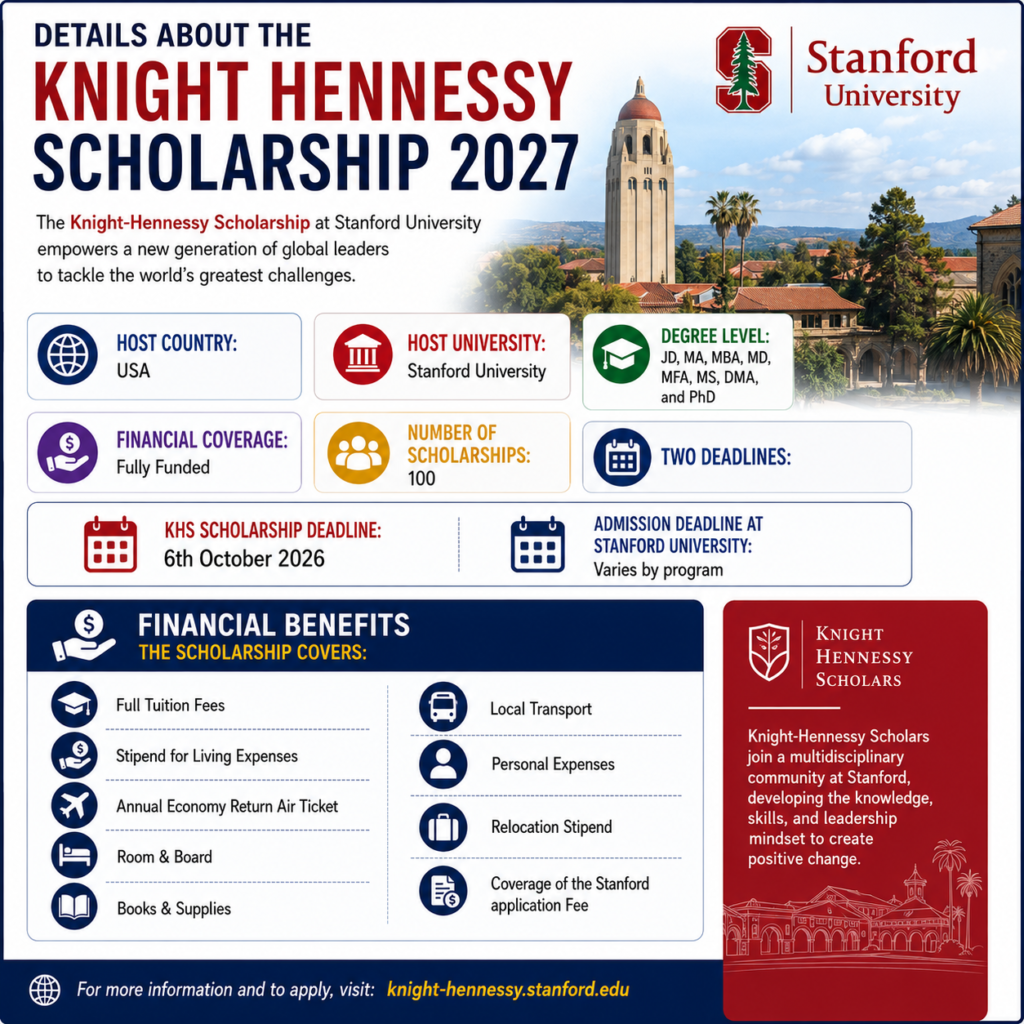
The Knight-Hennessy Scholars Program is Stanford’s flagship global scholarship and one of the most generous graduate scholarship programmes in the world. It provides full funding — tuition, living stipend, and health insurance — for up to 100 graduate students per year from any country to pursue any graduate degree at Stanford, across all Stanford schools including the School of Engineering, the School of Medicine, the Law School, the Graduate School of Business, the School of Earth Energy and Environmental Sciences, the School of Humanities and Sciences, and the School of Education.
The Knight-Hennessy Scholarship covers tuition and fees for the entire duration of the graduate programme, a living stipend of approximately $74,000 per year, and comprehensive health and dental insurance. Additionally, each Knight-Hennessy Scholar receives up to $15,000 per year in enrichment funding for research, travel, academic conferences, and professional development activities.
Selection for the Knight-Hennessy Scholars Program is based on three qualities: civic mindset, the disposition to serve and to pursue goals larger than personal gain; collaborative leadership, the ability to work across boundaries and to empower others; and independent thinking, the intellectual courage to form and act on independent judgments. The programme does not target specific academic fields and explicitly values diverse backgrounds and perspectives, making it genuinely accessible to African students across every academic discipline.
The application for Knight-Hennessy Scholars involves a primary application through the Knight-Hennessy programme portal, a separate admissions application to the Stanford graduate programme of the applicant’s choice, recommendation letters from three referees who can address the three selection qualities, and three essays that address the applicant’s civic engagement, leadership approach, and intellectual independence.
Stanford Graduate Fellowships in Science and Engineering
Stanford’s School of Engineering and School of Medicine both provide generous fellowship funding to admitted doctoral students through the Stanford Graduate Fellowship Programme and departmental fellowship awards. Virtually all doctoral students admitted to Stanford engineering and science programmes receive full funding — tuition, stipend, and health insurance — for the full duration of their PhD.
For African students with backgrounds in computer science, electrical engineering, mechanical engineering, bioengineering, chemical engineering, environmental engineering, or any other engineering and applied science discipline, admission to a Stanford PhD programme is effectively a fully funded scholarship. The strategy is therefore to focus entirely on the quality of the doctoral application — the research proposal, the academic record, the letters of reference, and the statement of purpose — rather than on a separate scholarship competition.
Stanford Law School — LLM and JSD Fellowships
Stanford Law School’s LLM programme is one of the most competitive and most globally distinguished in the world. For African lawyers, the LLM at Stanford provides both the prestige of a Stanford qualification and access to Stanford’s extraordinary network in technology law, constitutional law, international law, human rights, and environmental law.
Stanford Law School provides fellowship funding to LLM students based on merit and financial need. The fellowship application is submitted alongside the LLM admissions application, and applicants are evaluated for funding consideration as part of the overall admissions process. African lawyers with strong academic records, demonstrated professional experience in legal practice or public interest law, and a clear articulation of how the Stanford LLM connects to their specific professional goals are competitive candidates for fellowship consideration.
Stanford Africa Initiatives — Research and Academic Partnerships
Stanford has developed several institutional programmes that specifically support African students and researchers, including the Stanford Africa MBA Fellowship, which provides funding for African students admitted to the Stanford MBA programme from eligible African countries, and the Stanford-Africa Research Initiative, which supports collaborative research between Stanford faculty and African universities.
The Africa MBA Fellowship at Stanford GSB provides a partial fellowship — typically covering a significant portion of tuition — for students from Africa admitted to the Stanford MBA programme. Applications are submitted through the MBA admissions process, and candidates who wish to be considered for the Africa Fellowship indicate this in their application.